

Viaducts & Garden Paths at Park Güell
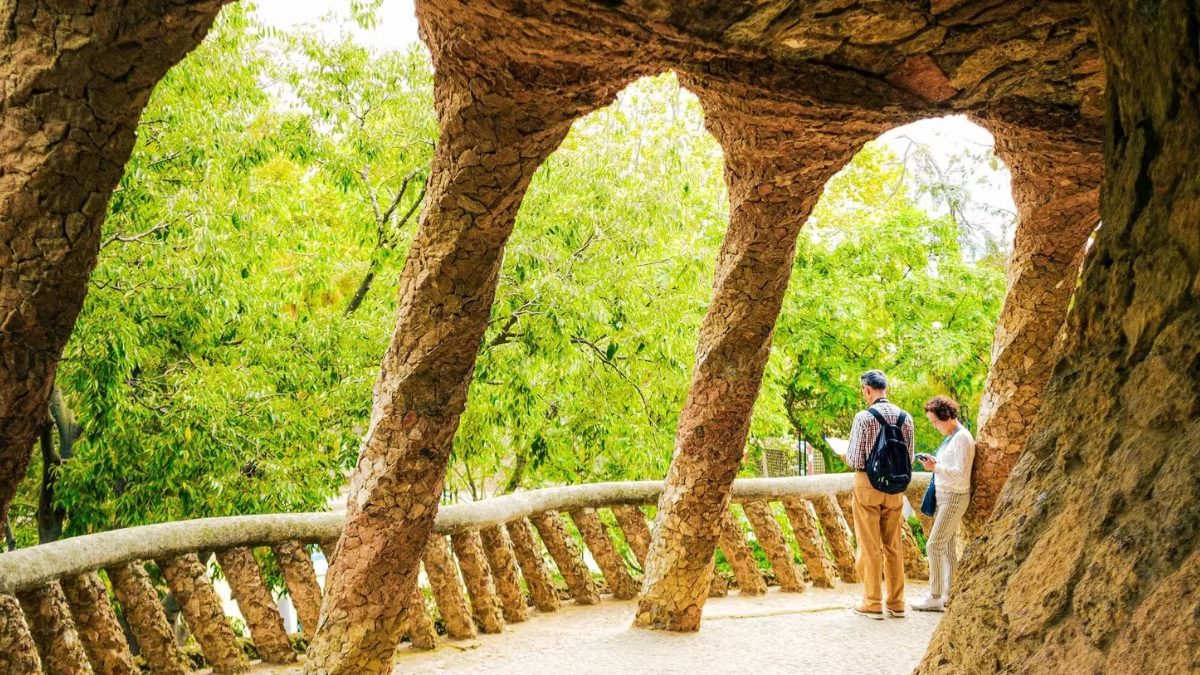
The viaducts and garden paths of Park Güell are in the free zone — no ticket required. Three elevated stone pathways (Pont de Baix, Pont del Mig, Pont de Dalt), each 5 metres wide and designed by Gaudí using local stone, thread through the park’s forested hillside. The Austria Gardens provide a quiet terrace with Mediterranean planting and city views. The forest trails lead to the Turó de les Tres Creus — the best panoramic viewpoint in the park, free and almost always uncrowded.
The Monumental Zone gets almost all the attention. El Drac, the Serpentine Bench, the Hypostyle Room — these are the images that fill every Barcelona travel guide and Instagram feed. But the viaducts and garden paths in the park’s free zone are, for many visitors, the more surprising discovery. They are quieter, shadier, structurally fascinating in their own right, and require no ticket, no timed slot, and no advance booking. In August, even the viaducts are nearly empty.
The Three Viaducts
Three elevated stone pathways (Pont de Baix, Pont del Mig, Pont de Dalt) thread through the park’s forested hillside, each 5 metres wide. Built from stone quarried directly from the hill during construction. Supported by columns that lean at calculated catenary angles to resist lateral load. The tops are planted with Mediterranean vegetation so the boundary between architecture and hillside disappears.
Gaudí designed three viaducts to serve the planned residential estate, each 5 metres wide. Originally intended to carry carriages from the main entrance up to the higher parts of the park, they are now walking paths that thread through the pine forest and connect the lower entrance areas to the hilltop.
| Viaduct | Catalan Name | Location | Character |
|---|---|---|---|
| Lower Viaduct | Pont de Baix | Near the Monumental Zone, east side | Most accessible; gentle gradient; leads from Carrer d'Olot area upward |
| Middle Viaduct | Pont del Mig | Mid-level on the hillside | Most dramatic; longest span; best views of the viaduct structure itself |
| Upper Viaduct | Pont de Dalt | Higher level, approaching Turó de les Tres Creus | Quietest; passes through dense pine forest |
What Makes the Viaducts Architecturally Significant
The viaducts are among Gaudí’s most technically impressive works within the park, and among the least discussed. Each one is built entirely from local stone quarried directly from Carmel Hill during construction — meaning the park is partially made from the material that was removed to create its paths. The stone is rough-hewn and uncut, giving the viaducts the appearance of natural rock formations rather than constructed bridges.
The supporting columns are not vertical. Like the outer columns of the Hypostyle Room, they lean at calculated angles — outward from the viaduct path to resist the lateral load of the elevated roadway above. Gaudí used inverted catenary arches (the same structural principle he would later apply to the Sagrada Família’s nave vaults) to ensure the load travels in pure compression with no tensile stress. The columns do not hold the path up the way conventional columns do — they push it up from below, like roots.
The tops of the columns and the viaduct walls are planted with Mediterranean vegetation — agave, rosemary, wild grasses — so the boundary between architecture and hillside disappears. Looking at the viaducts from below, it is genuinely difficult to tell where the natural rock ends and the constructed stone begins.
The Laundry Room Portico (Portico de la Bugadera), which connects to the lowest viaduct, is also worth noting: its inclined columns lean inward, resembling a wave frozen mid-motion. It is one of the most graceful structural experiments in the park and is visible from the Main Terrace above.
The Austria Gardens (Jardins d’Àustria)
The Austria Gardens occupy the eastern section of the park, at the level of the Carretera del Carmel entrance. They were established as a municipal nursery after the park opened to the public in 1922, and received their current name in 1977 when Austria donated a collection of trees during the “Vienna in Barcelona” exhibition.
The gardens are noticeably different in character from the rest of Park Güell: more formal, more symmetrical, with wide tree-lined paths rather than organic stone viaducts. This reflects their origin as a working nursery rather than a Gaudí design. They contain carob trees, Mediterranean plants, and views over the lower city that are less dramatic than the Main Terrace but consistently quieter and more peaceful.
The Austria Gardens are accessible without a ticket and are a good option for visitors who want to rest, eat a picnic, or simply find shade after the Monumental Zone. The gardens border the Carretera del Carmel entrance and are visible from the Austria Gardens area of the Monumental Zone.
The Forest Trails
Beyond the viaducts, the park’s forested hillside contains approximately 8 hectares of pine and Mediterranean woodland. The paths wind through dappled shade and are almost always quiet — even in peak summer, the forest sections of Park Güell see only a fraction of the Monumental Zone’s visitor numbers.
The trails connect the Carretera del Carmel entrance area to the Turó de les Tres Creus summit via a gradual uphill route through the forest. Wildlife present includes ring-necked parakeets, various species of thrush and tit, and in summer the hummingbird hawk-moth — a day-flying moth that hovers at flowers so rapidly it is frequently mistaken for an actual hummingbird. The forest floor carries wild rosemary, lavender, and pine resin in summer.
Turó de les Tres Creus (Hill of the Three Crosses)
The highest point in Park Güell at 182 metres, crowned by three iron crosses. The panorama covers the full Eixample grid, Sagrada Família on its central axis, the Mediterranean, Montjuïc, and Tibidabo silhouetted to the north-west. Free, uncrowded even in August, accessible at any time during park hours. No ticket required.
The destination that the viaducts and forest trails lead to is the highest point in the park at 182 metres — the Turó de les Tres Creus, or Hill of the Three Crosses. Three iron crosses on a stone base mark the summit: one pointing skyward, the other two oriented to the cardinal directions.
The panorama from the summit covers: – South-east: The full Eixample grid with the Sagrada Família towers rising on its central axis – South: The Barcelona waterfront, the port, and the Mediterranean (clearly visible on most days) – South-west: Montjuïc hill and castle – West: The Collserola hills – North-west: Tibidabo and the Serra de Collserola ridge
This is arguably the best free panoramic viewpoint in Barcelona. It is superior to the Main Terrace for the breadth and height of the view, and it is free, uncrowded, and accessible at any time the park is open. The only trade-off versus the Main Terrace is the absence of the Serpentine Bench in the foreground.
Recommended Walk: Viaducts to the Summit
This route combines the free zone highlights in approximately 45–60 minutes:
- Exit the Monumental Zone via Carretera del Carmel
- Walk north-east along the Austria Gardens
- Pick up the Pont de Baix (Lower Viaduct) path heading uphill
- Follow the viaduct level through the forest — notice the inclined column bases
- Continue via forest trails toward the Pont del Mig and Pont de Dalt
- Ascend the final stone steps to the Turó de les Tres Creus summit
- Spend time at the panorama before descending back via the forest path
The total ascent from the Carretera del Carmel entrance to the summit is approximately 30 metres over 10–15 minutes of walking. The paths are generally well-maintained stone, though some sections near the summit become uneven.
Frequently Asked Questions
Do the viaducts require a ticket?
No. The viaducts and all garden paths in the free zone are accessible without any ticket at any time the park is open.
Are the viaducts part of the Monumental Zone?
No. The main viaducts are in the free zone. There is a short viaduct section visible from the Main Terrace that forms part of the Monumental Zone structure, but the three main elevated pathways (Pont de Baix, Pont del Mig, Pont de Dalt) are in the free zone.
What is the best viaduct for photography?
The Middle Viaduct (Pont del Mig) offers the best combination of accessible viewpoints and visible structural character. The Lower Viaduct is the most accessible. The Upper Viaduct is the quietest and most forested.
How do I get to the viaducts from the Monumental Zone?
Exit via the Carretera del Carmel entrance and follow the free-zone paths north and east. The first viaduct path begins within 5 minutes’ walk of the Austria Gardens.
Is the Turó de les Tres Creus accessible without a ticket?
Yes — it is in the free zone and accessible at any time during park opening hours, with no ticket required.
