

Main Terrace & Serpentine Bench
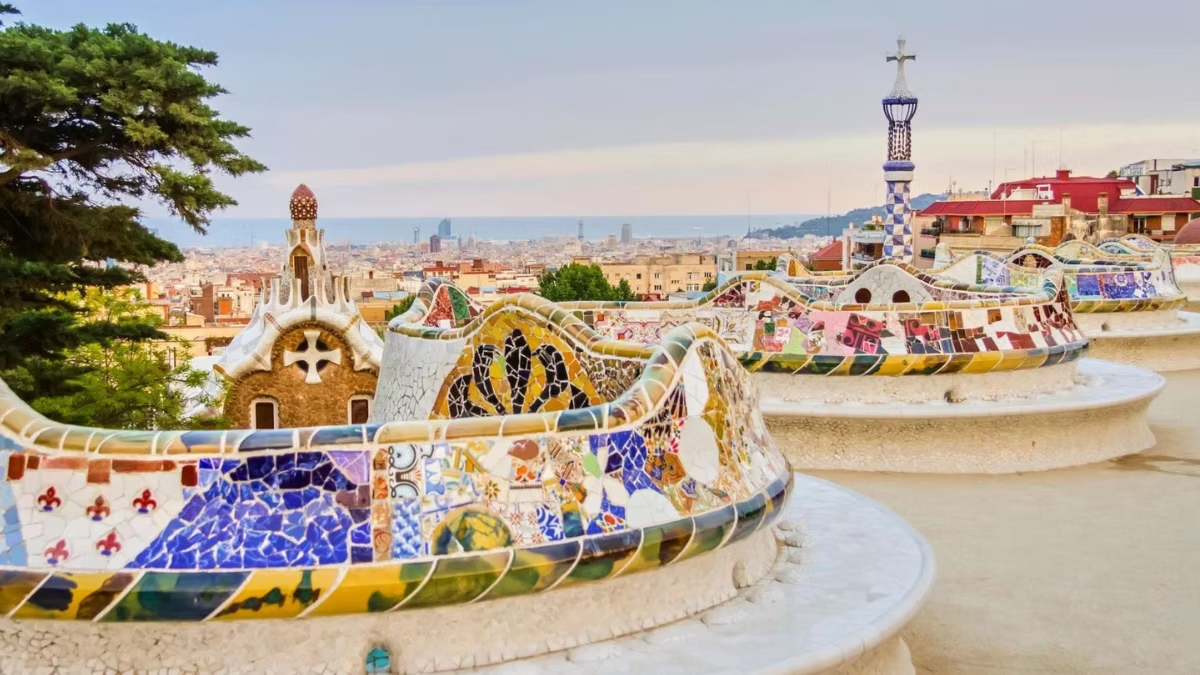
The Main Terrace (Plaça de la Natura) is the roof of the Hypostyle Room and the panoramic centrepiece of Park Güell. The Serpentine Bench — designed by Josep Maria Jujol and running 110 metres around the terrace’s perimeter — is simultaneously the world’s longest public bench, a rainwater drainage system, and one of the finest examples of trencadís mosaic in existence. Both are included with the standard €18 admission ticket.
You have seen this view ten thousand times in photographs. The undulating mosaic bench, the Barcelona skyline, the hazy line of the Mediterranean in the distance, the Sagrada Família towers rising through the Eixample grid. Standing on the Main Terrace of Park Güell and looking south, the photograph finally makes sense as a physical experience. The scale is larger than it looks in images. The bench is longer. The city is further below. And the mosaic, which photographs as a smear of blue and yellow, resolves at close range into an astonishing collage of individual ceramic fragments, each one placed deliberately, no two the same.
The Main Terrace: Facts and Function
| Official name | Plaça de la Natura (Nature Square) |
| Original name | "The Greek Theatre" |
| Dimensions | 86 metres long × 43 metres wide; 2,694 m² total area |
| Construction | 1907–1913 |
| Function (original intent) | Open-air theatre and community gathering space for the planned housing estate |
| Function (current) | Public terrace and panoramic viewpoint |
| Altitude | Approximately 150 metres above sea level |
The terrace was designed by Gaudí as the social heart of the planned housing estate — a “Greek Theatre” where residents would watch performances from the terrace itself or from the terraces of their surrounding homes (homes that were never built). The oval shape of the terrace was specifically designed for theatrical acoustics, with the Serpentine Bench providing audience seating around the performance area.
No theatrical performances were ever staged here. The estate collapsed commercially, the park opened to the public in 1922, and the Main Terrace became what it is today: a panoramic viewpoint, a photography destination, and a place where strangers from fifty countries sit side by side on the world’s longest mosaic bench and look at Barcelona spread below them.
The Serpentine Bench: Design and Dimensions
The Serpentine Bench runs 110 metres continuously around the Main Terrace perimeter. Designed by Josep Maria Jujol. Ergonomically shaped (reportedly moulded on a workman sitting in wet plaster). Covered in trencadís mosaic from discarded factory tiles. Functions simultaneously as seating, balustrade against the terrace drop, and drainage system — holes in the backrest channel rainwater to the Hypostyle Room below.
| Length | 110 metres (continuous undulating seat) |
| Designer | Josep Maria Jujol i Gibert (supervised by Gaudí) |
| Construction technique | Stone base covered in trencadís mosaic |
| Material | Broken ceramic tiles, fragments of china, crockery, glass, and mirror |
| Secondary function | Rainwater drainage system — holes in the backrest channel water to the Hypostyle Room below |
| Ergonomic design | Reportedly shaped by having a workman sit in wet plaster to mould the lumbar curve |
The bench wraps continuously around the full perimeter of the Main Terrace, creating a protective balustrade against the terrace’s edge-drop while simultaneously providing seating. At 110 metres, it is considered the longest undulating public bench in the world.
Josep Maria Jujol: The Bench’s True Creator
The Serpentine Bench is primarily Jujol’s work, not Gaudí’s. Gaudí provided the structural concept and overall form. Jujol provided the 110-metre mosaic surface — and in doing so produced what many consider the finest single example of the trencadís technique. He embedded pieces of his own household china, glass bottle bottoms, mirror shards, and cryptic symbols within the surface.
The design of the Serpentine Bench is primarily the work of Josep Maria Jujol i Gibert — Gaudí’s most gifted assistant, who also designed the ceiling of the Hypostyle Room below.
Gaudí provided the structural concept and overall form. Jujol provided the mosaic surface — and in doing so, produced what many consider the finest single example of the trencadís technique. He had what one contemporary described as “a great sense of colour and a poetry in the assembling of recycled elements”: the ability to take broken fragments and arrange them into a composition that is simultaneously chaotic and coherent, abstract and beautiful.
Jujol embedded hidden objects and symbols within the mosaic surface. Among the fragments of commercial ceramic tiles, he worked in pieces of china from his own home, glass bottle bottoms used as circular motifs, mirror shards that catch light unexpectedly, and — according to some researchers — cryptic Catholic symbols and private jokes for the workers who would sit on the bench after it was laid. The mosaic repays close looking: crouch down and examine a section at eye level, and the variety of individual fragments — their different ages, origins, and glazes — becomes visible.
The Drainage Function
Like almost every element in Park Güell, the Serpentine Bench has a hidden functional role. The junction between the seat surface and the backrest wall is interrupted by small drainage holes. Rainwater falling on the exposed terrace flows across the slightly inclined seat surface and exits through these holes, entering a conduit that runs through the Hypostyle Room’s hollow columns below and accumulates in the 1,200 cubic metre cistern beneath the room. This is the same water system that includes El Drac’s mouth as its overflow outlet on the staircase below. The bench, the columns, and El Drac are all components of a single integrated water management infrastructure.
The View from the Terrace
Park Güell faces south-east. From the Main Terrace: the Sagrada Família towers rise directly ahead aligned along the Eixample grid’s axis; the Mediterranean is visible on the horizon on clear days; Montjuïc and its castle lie to the south-west; Tibidabo and the Collserola hills are to the north-west. Golden hour turns the entire scene amber.
Park Güell faces south-east. From the Main Terrace:
- Directly south-east: The Eixample district’s grid of blocks, with the Sagrada Família towers rising on its axis
- South: The waterfront, Barcelona port, and the Mediterranean Sea (visible on clear days)
- South-west: Montjuïc hill and castle
- North-west: The Collserola hills and the silhouette of Tibidabo with its amusement park and church
The Sagrada Família towers are the focal point of the view — Gaudí designed them to be visible from the terrace, and they are framed perfectly by the curve of the bench from the western end. On the clearest days (typically after rain in autumn or winter), you can see the Balearic Islands on the horizon.
Photography on the Main Terrace
The Main Terrace is the most photographed location in Park Güell. Getting a usable photograph requires either timing or acceptance of people in the frame.
| Timing | Crowd Level | Light |
|---|---|---|
| 09:30–10:00 | Lightest | Soft morning light from south-east — warms the bench and city simultaneously |
| 10:00–11:30 | Building | Good light but growing crowds |
| 11:30–15:00 | Peak (summer) | Harsh overhead; bench crowded; avoid if possible |
| 15:00–17:00 | Thinning | Light improving |
| Last entry slot (~18:30) | Light | Golden hour — the bench glows amber; Barcelona skyline turns pink |
Classic shot (bench + skyline): Stand at the western end of the terrace and shoot east along the bench toward the Barcelona skyline. Morning light falls across the bench from the right; late afternoon light falls from behind, warming the city.
Detail photography: Crouch at bench level and shoot along the mosaic surface. The trencadís fragments create a receding texture that works beautifully with a long depth of field. This is also the angle that reveals the individual fragment variety that the standard tourist shot misses entirely.
Empty bench strategy: Arrive at the 09:30 slot and go directly to the terrace via the Hypostyle Room. The first 20–30 minutes after opening are the quietest on the bench. By 10:30 a continuous stream of visitors makes a clear shot difficult.
Frequently Asked Questions
Is the bench comfortable to sit on?
Yes — surprisingly so. The ergonomic lumbar curve makes it genuinely comfortable for extended sitting. The mosaic surface is cool in the morning and warm in the afternoon. The protective backrest wall prevents falls from the terrace edge.
How long is the Serpentine Bench?
110 metres, continuous, running around the full perimeter of the Main Terrace oval.
Who designed the bench mosaic?
Josep Maria Jujol i Gibert, Gaudí’s most talented assistant. The structural form was Gaudí’s; the mosaic surface is Jujol’s. Jujol also designed the Hypostyle Room ceiling and contributed to Casa Batlló and the Sagrada Família.
Can I see the Mediterranean from the terrace?
On clear days, yes — the Mediterranean is visible on the horizon south of the city. The clarity depends on atmospheric conditions. Autumn and winter days after rain offer the clearest views.
Why does the bench have holes in the backrest?
These are drainage holes — they channel rainwater from the terrace surface through the hollow Hypostyle Room columns below into the underground cistern. The bench is part of the park’s integrated water management system.
Is the bench currently under conservation?
Park Güell undertakes ongoing trencadís restoration. Sections of the bench have been closed at various points for conservation work. Check the disruptions page at parkguell.barcelona before visiting if this is a priority.
