

Main Highlights of Park Güell
The eight highlights of Park Güell are: the Dragon Staircase and El Drac, the Hypostyle Room, the Main Terrace and Serpentine Bench, the Porter’s Lodge Pavilions, the Laundry Room Portico, the Austria Gardens, the Viaducts, and the Turó de les Tres Creus viewpoint. The first five require a paid admission ticket (€18). The last three are in the free zone — no ticket, no closing time, no crowds.
Park Güell is more than the Dragon Staircase and the panoramic bench. Most visitors arrive knowing the two or three postcard images and leave having missed the acoustically perfect Hypostyle Room, the quiet Laundry Room Portico, and the hilltop viewpoint that delivers a better panorama than the Main Terrace for free. This guide covers everything worth seeing — in the order you encounter it on the recommended route — with enough context to understand what you are looking at.
Highlight 1: Porter’s Lodge Pavilions (Casa del Guarda)
Zone: Monumental (paid) | Time needed: 10–15 minutes
The two gingerbread-house gatehouses flanking the main entrance on Carrer d’Olot are often rushed past in the excitement of getting to the Dragon Staircase — but they deserve a pause. Designed by Gaudí and completed between 1900 and 1903, they were intended as a concierge office and waiting room for residents of the planned housing estate. The organic mosaic roofs, topped with white ceramic mushroom caps, introduced the trencadís technique on an architectural scale that Gaudí would refine throughout the rest of the park.
The right-hand pavilion (Casa del Guarda) is now a MUHBA exhibition space — entry is included with your park ticket. The exhibition covers Gaudí’s relationship with Barcelona and the original ambitions of the Güell housing project. It is worth 10 minutes of your visit for the context it provides for everything you see next.
Photography tip: The best shot of both pavilions together is from the Carrer d’Olot entrance esplanade, immediately on entry, before the crowd assembles on the staircase above.
Highlight 2: Dragon Staircase and El Drac
El Drac (the mosaic salamander) halfway up the entrance staircase is the most photographed feature in Park Güell. Arrive at the 09:30 slot for a realistic chance of a less-crowded shot — by 10:30 a queue of visitors waiting to pose with the creature forms and waits 5–10 minutes. El Drac sits above the overflow outlet of a 1,200m³ underground cistern.
Zone: Monumental (paid) | Time needed: 15–20 minutes
The grand double staircase is the park’s most photographed feature — and for good reason. The stairway is divided into three sections ascending from the main entrance to the Hypostyle Room above, flanked by retaining walls and two grottos. Halfway up the central flight sits El Drac: a mosaic salamander — locals call it a dragon, guidebooks hedge on “lizard” — covered in brilliant trencadís tilework that glitters blue, green, and gold in morning light.
El Drac is not purely decorative. The creature sits atop the overflow outlet of a 1,200 cubic metre cistern hidden beneath the Hypostyle Room. Rainwater from the Main Terrace flows through hollow columns in the room below, collects in the cistern, and exits through El Drac when the cistern is full. Gaudí’s park has no wasted surface.
Other details worth looking for as you climb: the Catalan coat of arms on the second landing, the goblin-like sculptural forms on the first landing, and the odeon bench (a small Greek-theatre shaped seat) sheltered under the Hypostyle Room at the top of the final flight.
Photography tip: Arrive at 09:30 for a realistic chance of a less-crowded shot. By 10:30 there is a queue of visitors waiting to photograph at the El Drac position. The best angle is from slightly below, looking up the staircase with the pavilions in the background.
Highlight 3: Hypostyle Room
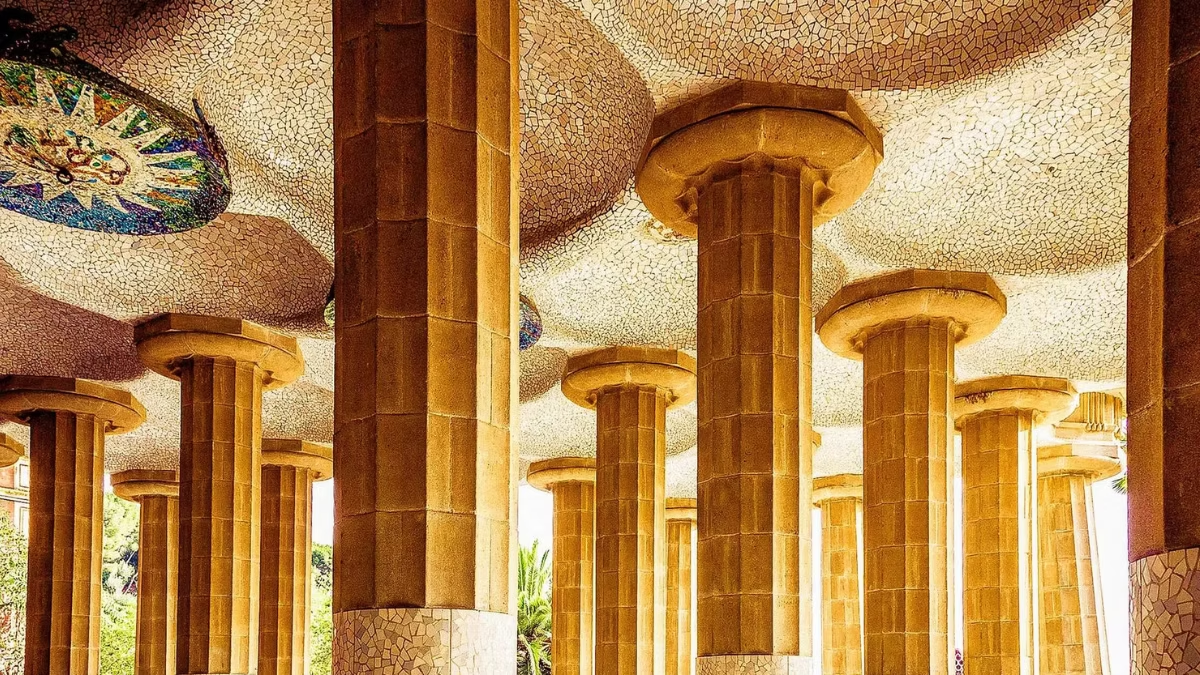
86 Doric-style columns support the Main Terrace above. The outermost columns lean outward at calculated angles to resist lateral load — a structural innovation Gaudí derived from Greek temples. The ceiling is decorated with 18 trencadís mosaic medallions by Josep Maria Jujol. The acoustics are extraordinary — designed for a marketplace.
Zone: Monumental (paid) | Time needed: 10–15 minutes
Immediately above the Dragon Staircase, the Hypostyle Room is one of the most architecturally significant spaces in Gaudí’s entire output. Eighty-six Doric-style columns support the weight of the Main Terrace above. The columns are not conventional: the outermost ring leans outward at a calculated angle to resist lateral forces — a structural innovation Gaudí derived from Greek temple engineering and adapted to his own organic sensibility. The columns are not solid stone either — they are hollow, and form part of the rainwater drainage system that channels water from the terrace above down to the cistern below.
The ceiling is decorated with four enormous circular mosaic medallions representing the four seasons, designed by Gaudí’s close collaborator Josep Maria Jujol. Each medallion is a dense collage of broken ceramic, bottle glass, and ceramic dolls’ heads embedded in the plaster — a technique Jujol developed as a way of making artistic use of urban waste. Look for the octopus, the ceramic cups, and the pieces of broken china worked into the decoration.
The acoustic of the room is extraordinary. Stand at the centre and the sound reflects off every surface simultaneously. Gaudí designed it as a marketplace — the acoustics would have served merchants shouting prices just as well.
Photography tip: Stand at the eastern end and shoot west with a wide angle to capture the columns receding in perspective. The light entering from the open terraces at both ends creates a natural gradient across the ceiling.
Highlight 4: Main Terrace and Serpentine Bench
The 110-metre Serpentine Bench runs around the full perimeter of the Main Terrace, providing ergonomic seating, drainage for rainwater, and one of Barcelona’s finest panoramas simultaneously. Designed by Jujol. The classic panorama shot: stand at the western end, shoot east along the bench with Barcelona below.
Zone: Monumental (paid) | Time needed: 20–30 minutes
The Main Terrace (Plaça de la Natura) is the roof of the Hypostyle Room and the centrepiece of Park Güell. It is an enormous open platform with panoramic views south over the entire city of Barcelona to the Mediterranean, framed by the Serpentine Bench along its full perimeter.
The Serpentine Bench runs 110 metres around the terrace’s edge, forming a continuous undulating seat that is simultaneously one of the world’s first ergonomically designed public benches (Gaudí reportedly had a workman sit in wet plaster to mould the lower-back curve) and a functional drainage system — holes in the backrest channel rainwater from the terrace surface down to the cistern below. The bench was designed by Josep Maria Jujol, who covered every surface with trencadís mosaic fragments in a riot of colours, patterns, and embedded objects.
From the terrace on a clear day: the Sagrada Família towers are visible directly ahead (south-east), aligned along the Eixample grid’s axis. The Barcelona port and the Mediterranean shimmer in the distance. The Collserola hills rise behind the city to the west. At golden hour, the entire scene glows amber.
Photography tip: For the classic shot, stand at the western end of the terrace and shoot east along the Serpentine Bench with Barcelona in the background. Arrive early (09:30 slot) for an unobstructed view of the bench itself, or at the last entry slot for golden light on the city.
Highlight 5: Laundry Room Portico
Zone: Monumental (paid) | Time needed: 10 minutes
The Laundry Room Portico (Portico de la Bugadera) is on the eastern side of the Main Terrace — often overlooked because most visitors are focused on the panorama. It is a curved vaulted walkway supported by inclined stone columns that Gaudí designed to resemble a wave frozen in stone. The name comes from its original purpose as a sheltered passage for residents doing laundry in the basins at its base.
The vaulting technique here — columns that lean dramatically outward, supporting arches that carry significant lateral load — is a structural experiment that Gaudí was working through simultaneously in the park’s viaducts. It is quieter than anywhere else in the Monumental Zone and worth stopping at before exiting.
Highlight 6: Austria Gardens
Zone: Free zone (no ticket required) | Time needed: 15–20 minutes
The Austria Gardens (Jardins d’Àustria) were added to the park in 1977 as a donation from Vienna during an exhibition titled “Vienna in Barcelona.” They sit on the eastern side of the park at the level of the Carretera del Carmel entrance — terraced gardens with Mediterranean planting, views over the city, and a quieter atmosphere than the Monumental Zone below. Accessible without a ticket and a good option for sitting down, catching your breath, and looking out over the city.
Highlight 7: Viaducts
Zone: Free zone (no ticket required) | Time needed: 20–30 minutes
Three elevated stone pathways cross the hillside of Park Güell, supported by inclined columns that Gaudí designed to follow the natural contours of the terrain rather than impose a grid upon it. The columns lean at angles calculated to carry load efficiently while appearing to grow organically from the hillside — they look like roots, or legs, or the branches of trees depending on your angle. They are among the most structurally innovative elements in the park and almost always completely quiet, even in peak season.
Walk the viaduct paths through the pine forest after your Monumental Zone visit. The forested sections smell of resin, the light is dappled, and the architectural details — each column custom-inclined to its specific position — reward careful attention.
Highlight 8: Turó de les Tres Creus
Zone: Free zone (no ticket required) | Time needed: 30 minutes (including 10-minute climb)**
The highest point in Park Güell at 182 metres, crowned by three iron crosses on a stone base. The panorama from the summit is arguably the best in the entire park: a near-360° view encompassing the Eixample grid to the south, the Mediterranean on clear days, Sagrada Família straight ahead, Tibidabo and the Collserola hills to the north-west, and the entire sweep of the city’s geography laid out below. Free, uncrowded even in August, and worth every step of the 10-minute uphill path from the Carretera del Carmel entrance.
Photography tip: This is the best free alternative to the Monumental Zone for panoramic photography — and on a clear day it is superior. Arrive at or shortly before sunset and stay as long as you like — there is no closing time in the free zone.
Frequently Asked Questions
Which Park Güell highlight is the most famous?
El Drac (the mosaic salamander on the Dragon Staircase) is the most photographed. The Serpentine Bench and its panoramic terrace is considered the most impressive. The Hypostyle Room is the most architecturally significant.
Which highlights are free?
The Austria Gardens, the Viaducts, and the Turó de les Tres Creus are all in the free zone and require no ticket.
Do I need a guided tour to understand the highlights?
Not strictly, but a guide transforms the visit significantly — the structural engineering of the columns, the symbolism in the Serpentine Bench mosaics, and the water management system hidden throughout the park are all invisible without context. See our Park Güell Guided Tour article.
Is the Gaudí House Museum included?
No — it requires a separate combined ticket. See our Park Güell + Gaudí House Museum Ticket article.
